
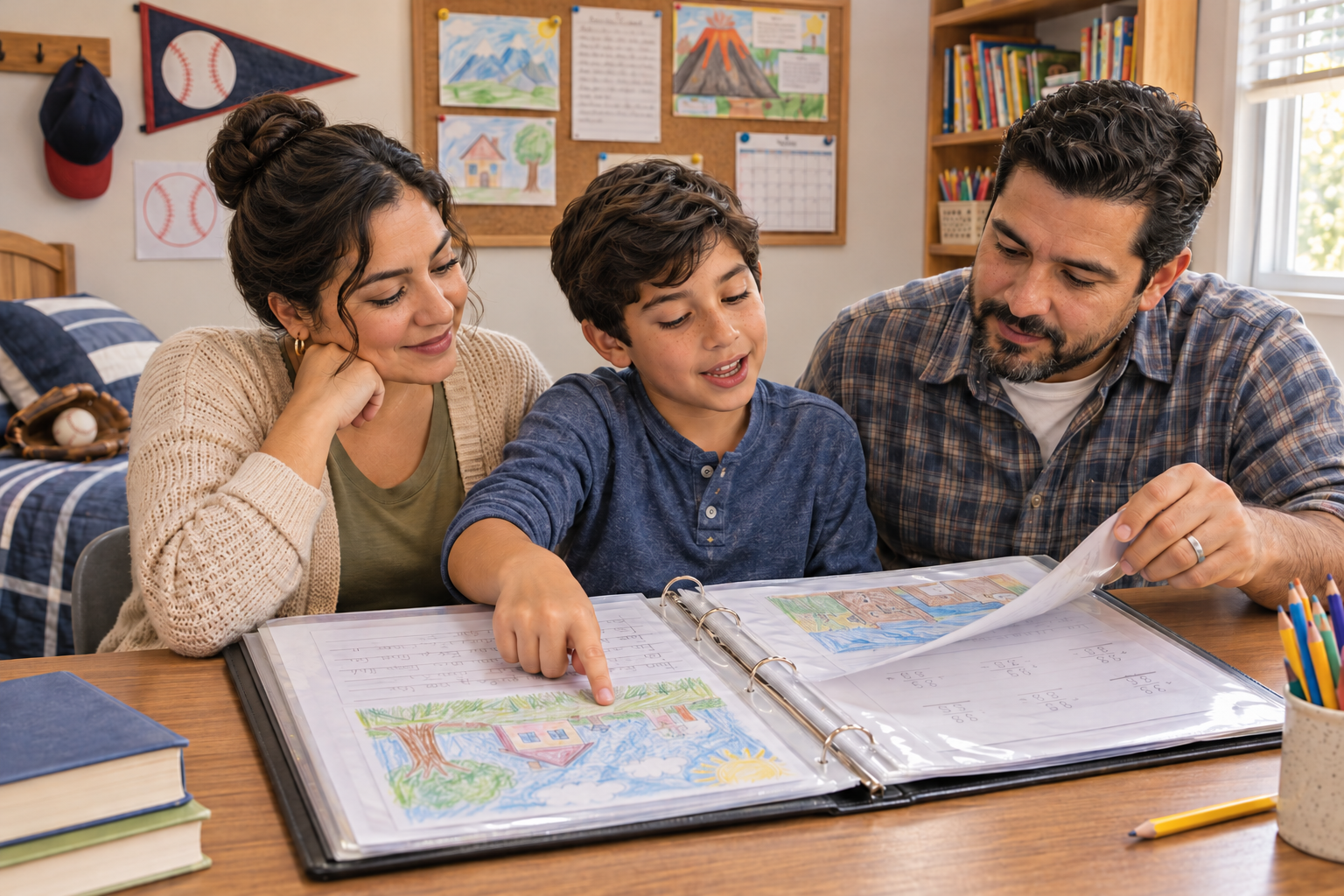
A portfolio is more than a binder of finished worksheets. For many homeschool families, it becomes a reassuring record of growth: the early handwriting sample beside a later paragraph, the math page that shows a new strategy clicking, and the reading log that reflects growing independence. This homeschool portfolio requirements guide helps California parents understand what to save, what may be required, and how to keep documentation useful without turning it into another full-time job.
Start With Your Homeschooling Path
California families do not all homeschool under the same arrangement, so portfolio expectations can look very different from one family to the next. Before gathering papers, identify the program or legal path your family uses.
Families who file a Private School Affidavit operate a private homeschool. California requires private schools to maintain certain records, including attendance records, courses of study, and teacher qualifications. A formal student portfolio is not generally a statewide requirement for families filing a Private School Affidavit. Still, creating one is a wise practice. It gives you a clear picture of your child’s progress and provides organized documentation if you ever need to describe the education you are providing.
Families enrolled in a public charter homeschool or independent study program usually have more specific requirements. A credentialed teacher or educational facilitator may request work samples, learning logs, attendance records, assignments, and periodic assessments. The required format, submission schedule, and amount of work can vary by program and grade level.
If your child is enrolled through a private school satellite program, ask that program directly what it expects you to retain and submit. The most helpful rule is simple: follow your school or program’s written requirements first, then build a portfolio that tells the fuller story of your child’s learning.
What to Include in a Homeschool Portfolio
A strong portfolio does not need to include every page your child completes. In fact, an overstuffed binder can make it harder to see meaningful growth. Choose representative pieces that show skills developing over time, along with records that explain how learning took place.
For elementary students, include samples from the core subjects. A beginning-of-year, middle-of-year, and later writing sample can show remarkable progress in spelling, sentence structure, organization, and confidence. For math, keep a few assignments that show your child’s thinking, not only pages with perfect answers. A challenging problem with corrections can be more informative than a routine worksheet.
Reading documentation can include a book list, a reading log, oral-reading notes, comprehension activities, or a short parent observation. For science and social studies, photographs of projects, notebook pages, maps, experiment notes, museum reflections, and brief summaries all work well. Young learners may also benefit from photos of hands-on activities, labeled artwork, or a short note about an activity they completed orally.
Most families benefit from keeping these four categories together:
- Attendance or learning-day records
- A course list or simple learning plan
- Selected work samples from core subjects
- Progress notes, assessments, or teacher feedback
You can also add enrichment experiences that matter to your child’s education, such as field trips, library programs, music study, physical education, community classes, or volunteer activities. These items should support the story of learning, not become a scrapbook obligation.
Save Growth, Not Just the Best Work
Parents naturally want to save beautiful finished work. That has value, but a useful portfolio also includes a few pieces that reveal effort and development. Keep an early phonics page, an early journal entry, or a math assignment your child initially found difficult. Pairing it with later work makes academic progress visible and gives children evidence that practice pays off.
This approach is especially encouraging for students who are closing learning gaps. A child who once avoided reading may be proud to see that they can now finish a chapter book or explain what happened in a story. That confidence is part of the educational record, too.
A Simple Organization System That Lasts
The best portfolio system is one you will actually maintain. Some families prefer a large binder with dividers for each subject. Others use a labeled file box, a folder for each month, or a digital folder with scanned work and photographs. There is no single correct choice.
For busy parents, a hybrid approach often works well. Keep paper originals in a simple folder or binder, then take clear photos of bulky projects and upload them to a digital folder. Name files consistently, such as “2026-09-Reading-Comprehension” or “2026-11-Math-Fractions.” A quick naming system prevents the end-of-year scramble to identify undated pages.
Set aside 10 to 15 minutes once or twice a month to choose work samples and add a few notes. Waiting until spring can make the process feel overwhelming, especially when you are also teaching, planning, and caring for younger siblings.
Write Brief Parent Notes
Short notes add context that a worksheet cannot provide. You might write, “Read this passage independently after practicing vowel teams,” or “Used manipulatives to solve two-digit subtraction.” These observations are particularly valuable for early elementary learners, whose progress may show up through conversation, persistence, and hands-on work before it appears in polished written assignments.
Keep notes factual and specific. Rather than writing “doing better in math,” write, “Can now explain regrouping with base-ten blocks and complete most problems independently.” Specific observations help you adjust instruction and communicate clearly with a supervising teacher, evaluator, or future school.
The Homeschool Portfolio Requirements Guide for Reviews
If your charter program, private school satellite program, or evaluator reviews your portfolio, ask early what they want to see. A review may involve a meeting, uploaded samples, a work log, or a combination of these. Some programs request samples from specific subjects or months, while others focus on whether the student is making reasonable progress toward their learning plan.
Prepare for a review by organizing materials in chronological order and selecting a manageable number of representative samples. Bring or upload the requested records, but do not assume more paperwork is always better. Clear documentation, a current learning plan, and a few strong examples of progress are usually more helpful than hundreds of loose pages.
If your child has struggled in an area, be honest about it. Homeschooling allows families to respond to learning needs with targeted instruction, extra practice, and a slower or different approach when necessary. Document the support you have provided and the next steps you plan to take. Progress is not always linear, particularly in reading development, writing, or foundational math.
Questions Parents Often Ask
Do California homeschoolers have to keep a portfolio?
It depends on your homeschooling arrangement. A formal portfolio is not generally a statewide requirement for parents operating under a Private School Affidavit, although private-school recordkeeping requirements still apply. Charter homeschool and independent study families may have portfolio or work-sample requirements set by their individual program.
How many work samples should I keep?
Keep enough to show progress across the year, not every assignment. For many elementary students, two to four meaningful samples per subject each semester, plus assessments or progress notes, creates a clear record. Your supervising program may request more specific documentation.
Should I include test scores?
Include them if your program requires them or if they help explain your child’s progress. Test scores are one data point, not the complete picture. Work samples, observations, and skill-based assessments can show strengths that a single test may miss.
What if my child learns mostly through projects and discussion?
Document it. Take photographs, save project plans, write a short summary of what your child learned, and record books, materials, or places explored. For oral learning, jot down a few sentences about the questions your child answered or the concepts they explained.
A well-kept portfolio should support your child, not pressure them to perform for a binder. When you save a small collection of meaningful work throughout the year, you create a record that honors real learning, helps you notice next steps, and reminds your child how far they have come. Families who would like personalized help documenting progress or strengthening foundational skills can also seek guidance from a trusted homeschool support provider, such as OC Learning Edge.