
A child may remember that the bear found a picnic basket or that the princess lost her shoe, yet still struggle to explain what happened first, next, and last. That is where learning how to teach story sequencing becomes especially valuable. Sequencing helps young readers turn a collection of story details into a meaningful chain of events – a foundational skill for reading comprehension, writing, speaking, and confident classroom participation.
For preschool and elementary-age children, story sequencing should feel concrete, visual, and manageable. The goal is not to have a child memorize a perfect retelling. It is to help them notice that stories follow an order, that events affect one another, and that readers can use this order to understand what they read.
Why Story Sequencing Matters for Early Readers
Story sequencing is the ability to identify and explain events in the order they occurred. Most often, children begin with a simple beginning, middle, and end structure. As their reading skills grow, they can learn to include details such as the problem, important events, character actions, and resolution.
This skill supports far more than a reading worksheet. When children can sequence a story, they are better able to answer comprehension questions, predict what may happen next, summarize a book, and write organized narratives of their own. It also strengthens oral language. A child who can tell a story in order is easier to understand and often feels more comfortable sharing ideas with adults and peers.
Sequencing can be particularly helpful for children who are still building vocabulary, learning English, experiencing reading gaps, or becoming overwhelmed by longer texts. A predictable framework gives them a way into the story. Instead of trying to hold every detail in their head, they can focus on one event at a time.
Start With Real-Life Routines Before Books
Before asking a child to sequence a story, practice sequencing events from their own day. Real-life routines are familiar, low-pressure, and easy to picture. You might ask, “What did we do before we came to tutoring?” or “What happens when we get ready for bed?”
Encourage complete answers using time-order words such as first, next, then, after that, and finally. For example: “First, I put on my pajamas. Next, I brush my teeth. Then, we read a book.” If a child gives the events out of order, respond warmly: “Yes, we do read a book. Do we read before or after you brush your teeth?”
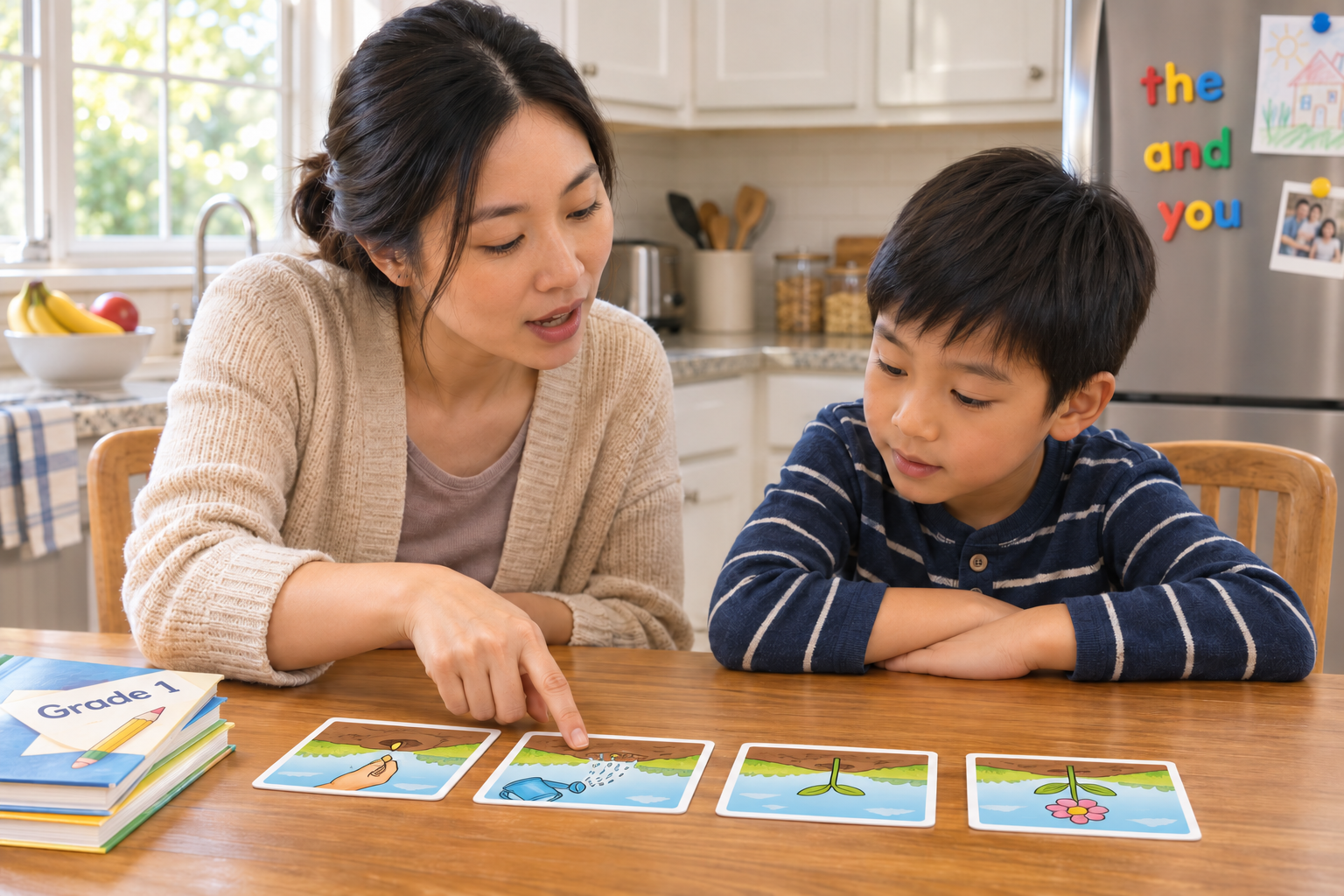
This kind of conversation builds the language of sequencing without making it feel like a test. Cooking, planting seeds, getting dressed, and packing a backpack also provide useful opportunities. Take photos of a simple activity, print them if possible, and invite your child to put the images in order. Children who need more support often benefit from physically moving picture cards rather than only answering verbally.
How to Teach Story Sequencing With Read-Alouds
Read-aloud time is one of the most natural ways to teach sequencing because it keeps the focus on enjoying a story together. Choose books with clear event patterns, expressive illustrations, and a manageable number of important actions. Repetitive stories and familiar folktales work well because children can hear how events build from one page to the next.
Before reading, look at the cover and ask what the child thinks the story might be about. During the book, pause briefly at meaningful moments. Questions such as “What just happened?” or “What do you think the character will do next?” help children stay connected to the sequence without interrupting the flow too often.
After reading, avoid beginning with the broad question, “What happened in the story?” Some children will not know where to start. Offer a clear prompt instead: “Tell me what happened at the beginning.” Once they answer, continue with, “What happened next?” and “How did the story end?”
If the child skips an event, gently return to the book. Turn to a page and say, “Let’s use the pictures to help us remember.” This teaches an important reading habit: strong readers return to the text for support. The child does not need to recall every small detail to succeed. Focus first on the events that move the story forward.
Use Story Language Children Can Hold Onto
A simple sequence frame gives young readers structure while leaving room for their own words. Try: “In the beginning, ____. Next, ____. Then, ____. At the end, ____.” For children who are ready for more depth, add: “The problem was ____,” and “The problem was solved when ____.”
It helps to model a retelling before expecting an independent one. You might say, “In the beginning, the character wanted to find her lost dog. Next, she asked her neighbors for help. Then, she looked at the park. At the end, she found the dog near the playground.” Keep your model short and clear.
Children sometimes believe that a good retelling means repeating every page. Reassure them that they are telling the most important parts. This distinction between key events and extra details takes time, especially for children who enthusiastically notice everything in a picture.
Make Sequencing Hands-On and Playful
Worksheets can provide useful practice, but they should not be the only approach. Young children often learn more deeply when they can draw, move, build, and act out what they know. After a shared story, invite your child to draw three or four event pictures. Ask them to tell the story as they point to each drawing.
Picture cards are another effective option. Write or draw one event on each card, mix them up, and have the child place them in order. Begin with three cards for a child who is new to the skill. Add more events only when they can explain the order with confidence. Too many cards at once can turn a helpful challenge into frustration.
Acting out a story can be especially supportive for active learners and children who have difficulty expressing ideas on paper. Use simple props, stuffed animals, or paper puppets. As the child performs each event, prompt them to use sequence words. The physical movement can make the story order more memorable.
For children who enjoy building, ask them to create a beginning, middle, and end scene with blocks, toy figures, or craft materials. The finished creation becomes a visual guide for retelling. It is also a useful way for parents and educators to see whether a child understands the story even if writing is still difficult.
Adjust Support to Your Child’s Needs
Not every child needs the same level of structure. A preschooler may do well with two pictures and the words first and last. A kindergartner or first grader may be ready for beginning, middle, and end. By second or third grade, many students can identify a character’s problem, major events, and resolution in a short text.
If your child finds sequencing challenging, start small. Offer two choices: “Did the character go to the store first, or did she bake the cake first?” Use illustrations, point to the relevant page, and revisit the story over several days. Reading a familiar story again gives children more room to notice how its events fit together.
If your child is ready for a greater challenge, explore why events happened in that order. Ask, “Because the character forgot her lunch, what happened next?” Or invite them to change one event and imagine a different ending. These conversations help children move beyond remembering events to understanding how they connect.
If you’re unsure what to try next, you don’t have to work it out alone. An educator can offer a fresh approach and guidance tailored to your child. Explore OC Learning Edge’s homeschool support options to see how we can complement the learning you’re already doing together.
Connect Story Sequencing to Writing
Once a child can retell events orally, they are ready to use sequencing in writing. Start with a shared experience, such as visiting a park, baking cookies, or completing a science activity. Ask the child to tell the events aloud before writing. Then help them turn each part into a sentence.
A beginning-middle-end organizer can be useful, but keep the writing task appropriately small. Three strong sentences that follow a logical order are more valuable than a long paragraph that leaves the child discouraged. Praise specific progress: “You helped your reader understand what happened first,” or “Your ending tells us how the problem was solved.”
Over time, sequencing becomes less of a separate lesson and more of a habit. Children begin to listen for order, read with greater purpose, and write stories that make sense to others. With patient practice, clear language, and stories they genuinely enjoy, each child can grow into a reader who does not simply remember a book, but understands how its events fit together.
 Have questions about your child’s learning? OC Learning Edge is here to listen and help you explore what fits.
Go to oclearningedge.com.