
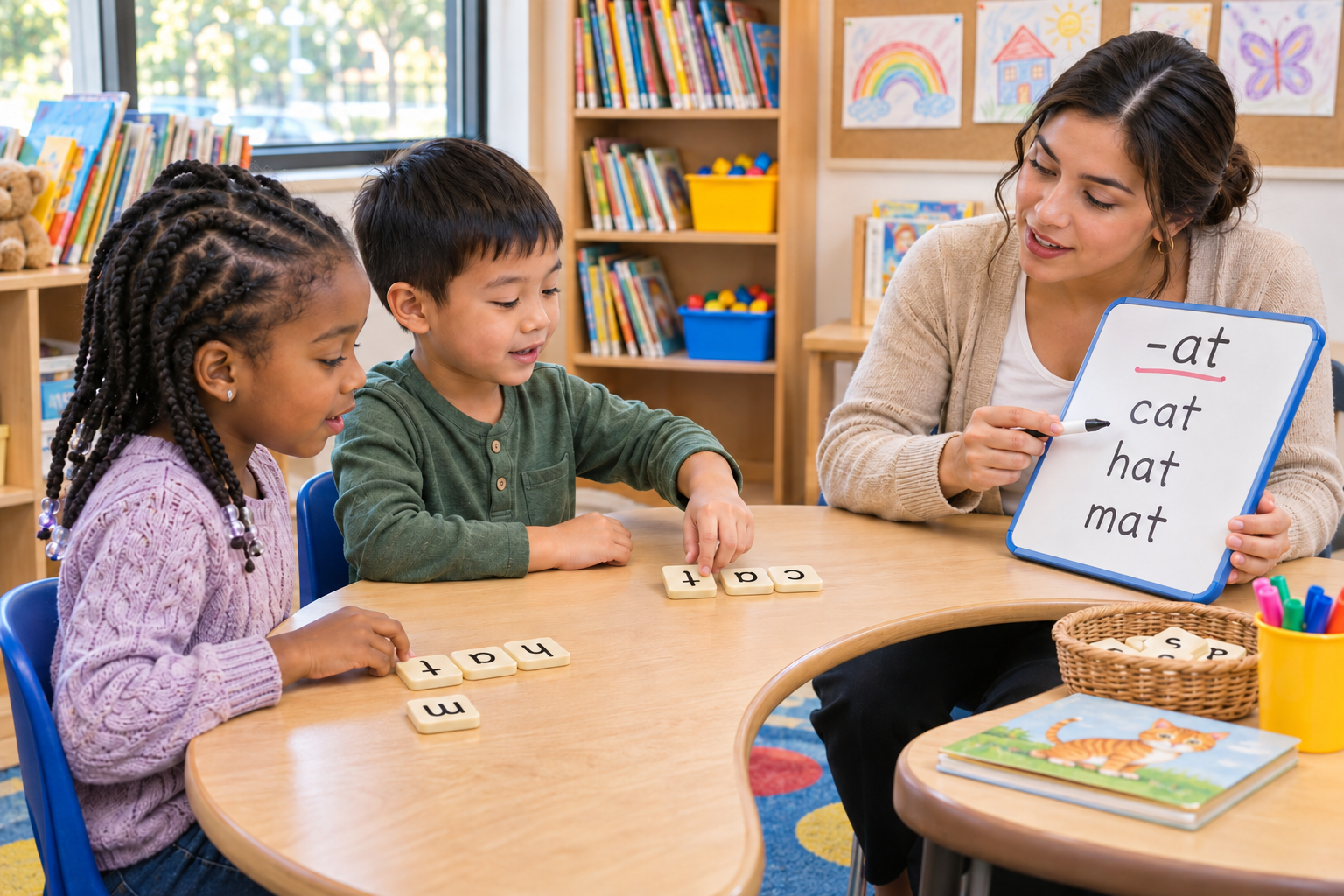
A child may understand a new reading strategy one day, then hesitate to use it in class the next. They may know their math facts at home but freeze when asked to explain their thinking. Semi-private tutoring benefits young learners because it gives them a smaller, more supportive space to practice skills, ask questions, and build the confidence to keep trying.
For many Orange County families, the choice is not simply between one-on-one tutoring and a large class. Semi-private instruction offers a thoughtful middle ground: personalized academic support alongside the encouragement and connection that can come from learning with one or two peers.
What Is Semi-Private Tutoring?
Semi-private tutoring is a small-group learning format, often with two or three students working with one instructor. Students may be close in age and working toward similar goals, such as stronger phonics skills, reading comprehension, writing, or foundational math.
It is not a mini classroom where every child is expected to move at the same pace. A skilled tutor plans instruction around shared needs while still noticing each child’s strengths, misunderstandings, and progress. One student may need extra practice blending sounds, while another may be ready to read with more fluency. Both can receive meaningful guidance within the same session.
This model can work especially well for preschool and elementary-age children, whose learning often grows through both direct instruction and positive peer interaction.
7 Semi-Private Tutoring Benefits for Children
1. More personal attention than a typical classroom
In a larger classroom, teachers work hard to meet many needs at once. Still, a child who is confused, quiet, or working below grade level may not always receive immediate support. In a semi-private setting, the tutor has more time to listen closely to each student and respond in the moment.
That can mean correcting a pencil grip before it becomes a habit, revisiting a misunderstood math concept, or giving a child another chance to explain a reading passage in their own words. Small adjustments like these help prevent learning gaps from growing.
2. A gentler place to ask questions
Some children are comfortable raising their hands in school. Others worry about getting an answer wrong or taking too long. A group of two or three feels less intimidating than a full classroom, yet it still helps children get used to speaking up around others.
When a tutor creates a warm, patient environment, children learn that questions are part of learning, not a sign that they have failed. This shift is especially valuable for students who have started to believe they are “not good” at reading, writing, or math.
3. Helpful peer modeling without constant comparison
Children often learn by watching another child work through a problem, sound out a word, or organize an idea before writing. Seeing a peer use a strategy can make that strategy feel more approachable. A student may think, “I can try that too.”
The key is careful group matching. Children should have compatible learning goals and personalities, not be placed together simply because they are the same age. Strong semi-private instruction keeps the focus on individual growth rather than turning learning into a competition.
4. More opportunities to practice communication
Academic success is not only about knowing the answer. Children also need to describe their thinking, listen to directions, take turns, and respond respectfully when someone else shares an idea. These are skills that support classroom participation, homeschool co-ops, and everyday confidence.
During a small-group reading lesson, for example, one child might share a prediction while another points to evidence in the text. In a math session, students can compare two ways to solve the same problem. These exchanges make learning active and help children understand that there is value in their own voice.
5. Confidence built through shared progress
One-on-one tutoring can be a wonderful fit, particularly when a child needs intensive intervention or has very specific goals. Yet some children feel encouraged when they realize they are not the only ones practicing a skill. A peer who is also working on vowel sounds, multiplication, or sentence structure can make the process feel less lonely.
Small celebrations matter. Finishing a first chapter book, writing a complete paragraph, or solving a problem independently can feel even more meaningful when children encourage one another. Over time, these moments can help students approach academic challenges with greater resilience.
6. Focused support for foundational skills
Early elementary years are when children develop the building blocks for future learning. If phonics patterns are unclear, reading can become frustrating. If number sense is shaky, later math concepts may feel confusing. If handwriting and sentence formation are difficult, children may avoid writing altogether.
Semi-private tutoring gives students repeated, guided practice in these essential areas. The tutor can use games, manipulatives, decodable texts, discussion, and structured practice to keep lessons engaging while still moving toward clear goals. The format is especially helpful when two or three students need support in the same core skill area but benefit from individualized feedback.
7. A meaningful balance of value and individualized care
For families who want personalized instruction but need a more flexible option than private tutoring, semi-private sessions can offer excellent value. Because the tutor’s time is shared among a very small number of students, families can often access targeted support at a different price point while their child still receives close attention.
Value, however, should never be measured by cost alone. The right program includes thoughtful placement, clear learning goals, consistent communication, and instruction that responds to a child’s progress. A smaller group is beneficial only when it is intentionally designed to serve the students in it.
When Semi-Private Tutoring Is the Right Fit
Semi-private tutoring can be a strong choice for children who would benefit from academic support and enjoy learning near peers. It often works well for beginning readers who need phonics practice, students strengthening comprehension, children building writing confidence, or learners who need extra support with grade-level math.
It can also be a helpful option for homeschool families looking for structured instruction and age-appropriate social interaction. A small group gives children a chance to practice learning with others while still receiving more guidance than they would in a traditional class setting.
There are times when private tutoring may be the better starting point. A child with significant learning gaps, a highly individualized learning plan, or strong anxiety around peers may need one-on-one support first. Once they gain skills and confidence, a semi-private setting may become a comfortable next step. The best choice depends on the child, not on a one-size-fits-all model.
What Parents Should Look for in a Small-Group Tutor
The quality of the group matters as much as the group size. Ask how students are matched and whether the tutor assesses skills before placing children together. Children do not need to be identical learners, but their instructional needs should be close enough that each child can participate successfully.
Parents should also look for clear goals. A tutor should be able to explain what the child will practice, how progress will be observed, and how instruction will change when a skill is mastered or needs more review. For young learners, a nurturing approach is equally important. Children make more progress when they feel safe making mistakes.
At OC Learning Edge, semi-private instruction is designed to support foundational skills while helping children feel capable, encouraged, and eager to learn. The goal is not to rush children through a worksheet. It is to give them the tools and reassurance they need to take the next academic step with confidence.
A child does not have to struggle alone, and they do not have to learn in a crowd. With the right small group, patient instruction, and goals that fit their needs, steady progress can begin to feel possible – and even exciting.

Let’s find your child’s next step. Have questions about your child’s learning? We’re to listen and help you explore what fits.
Go to oclearningedge.com and schedule a consultation today!