
A blank page can feel surprisingly big to an elementary-age child. The most effective top elementary writing exercises make that page feel smaller by giving children a clear starting point, a manageable goal, and permission to share their own ideas. When writing practice is consistent and encouraging, children build more than spelling and grammar skills. They learn to organize thoughts, communicate clearly, and trust that their voice matters.
For parents, the goal is not to turn every afternoon into a formal language arts lesson. A short, well-chosen activity can strengthen foundational skills while keeping writing connected to imagination, curiosity, and real life. The exercises below work well at home, in homeschool settings, or alongside classroom instruction.
What Makes an Elementary Writing Exercise Worth Doing?
A useful writing activity asks for just enough challenge. If a child is still learning to form letters and spell common words, asking for a five-paragraph essay can create frustration. If an older child only copies sentences, however, they may not get enough practice developing and organizing original ideas.
Start with what your child can do independently, then offer support for the next small step. A beginning writer may tell you a sentence before writing it. A more experienced writer may use a simple organizer before drafting a paragraph. This gradual support helps close learning gaps without making children feel behind.
It also helps to separate drafting from correcting. When a child is trying to generate ideas, avoid stopping them for every capital letter or spelling error. Let the first draft carry the story or message. Then choose one or two editing skills to practice, such as ending punctuation and capitalizing names. This approach protects confidence while building accuracy over time.
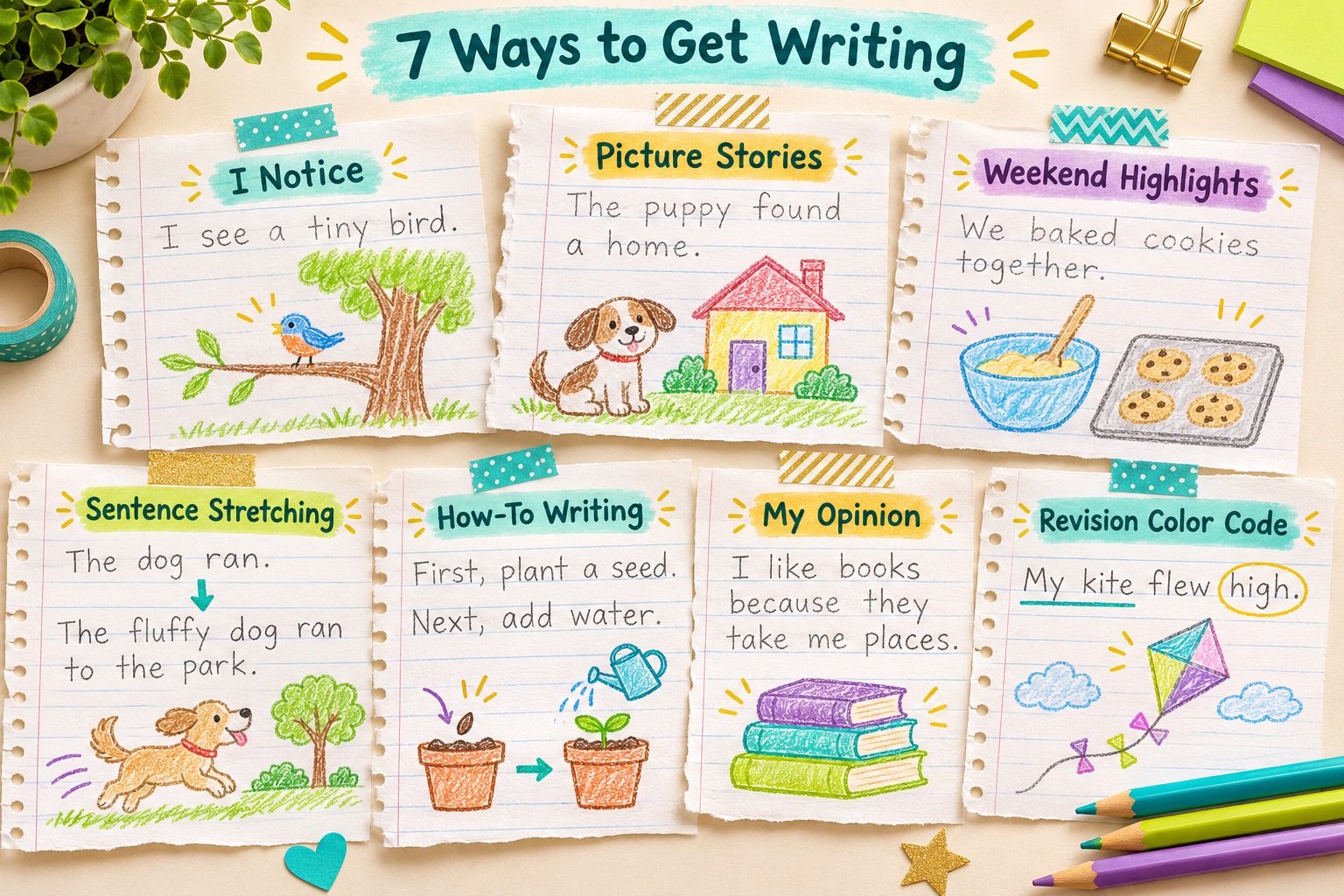
7 Top Elementary Writing Exercises to Try
1. The “I Notice” Writing Walk
Take a short walk around the yard, neighborhood, park, or even one room of the house. Ask your child to notice five specific details: something they see, hear, smell, feel, and wonder about. Back inside, have them turn those observations into three to five sentences.
For younger children, a sentence frame can make the task easier: “I noticed ___.” “It sounded like ___.” “I wondered why ___.” Older students can use their notes to write a descriptive paragraph. This exercise teaches children that good writing begins with paying attention, not waiting for a perfect idea.
2. Picture-to-Paragraph Stories
Choose an interesting photograph, postcard, illustration, or family picture. Instead of asking, “What do you see?” invite your child to imagine what happened just before the picture and what might happen next. This creates a natural beginning, middle, and end.
A kindergartener or first grader may draw a scene and label it before dictating or writing one sentence. Students in second through fifth grade can write a paragraph or short story using details about the setting, characters, problem, and solution. If your child gets stuck, ask gentle questions: Who is this? What do they want? What is getting in the way?
3. The Weekend Highlight, With Details
Personal writing is often the easiest place to begin because children already know the subject. Rather than the broad prompt “Write about your weekend,” ask them to select one small moment. Maybe it was baking cookies, visiting a cousin, scoring a goal, or building a blanket fort.
Encourage them to add details that help a reader picture the moment. What did the cookies smell like? Who was there? What did the child say, think, or feel? This exercise develops the important habit of expanding an idea instead of listing events. It can become a weekly routine and a meaningful record of your child’s growing voice.
4. Sentence Stretching
Many young writers produce short, correct sentences but need help making them more informative. Begin with a simple sentence, such as “The dog ran.” Then invite your child to stretch it by answering a few questions: Which dog? Where did it run? How did it run? Why?
“The small brown dog ran quickly across the wet grass to catch his red ball” gives a child a clear example of how words add meaning. Do not expect every sentence to become long. The purpose is to show that writers make choices. After a few examples together, let your child create and stretch their own sentence.
5. How-To Writing From Real Life
Procedural writing helps children practice sequencing, clarity, and audience awareness. Ask your child to explain how to do something they know well, such as making a sandwich, caring for a pet, tying shoes, building with blocks, or playing a favorite game.
Have them say the steps aloud first. Then help them write the steps in order using transition words such as first, next, then, and finally. Younger writers can draw a picture for each step and add labels or short sentences. Older children can add materials, safety reminders, and a closing tip. This exercise is especially helpful for children who struggle to organize ideas because the sequence already exists in their minds.
6. Opinion Writing With a Real Audience
Children are usually eager to share an opinion when the topic feels relevant. Offer a choice between two familiar options: Should recess be longer? Is a pet better than a video game? Should bedtime change on weekends? The question does not need to be serious to teach serious writing skills.
Ask your child to state an opinion, give two reasons, and end with a sentence that restates their point. For example, “I think our family should have a pet because pets can be comforting and teach children responsibility.” If they are ready, encourage examples to support each reason. Writing a note to a family member or creating a small poster can make the audience feel real and motivate careful work.
7. The Revision Color Code
Revision can feel discouraging when it is presented as a page full of corrections. A color-coding activity makes the process more concrete and positive. After your child drafts a paragraph, ask them to use one color to underline the main idea, another color to circle supporting details, and a third color to mark a strong word or sentence they are proud of.
Then identify one place to improve. Perhaps the paragraph needs one more detail, a clearer ending, or a transition word. Limiting revision to one meaningful goal helps children see editing as strengthening their work, not proving that it was wrong.
How Often Should Children Practice Writing?
Short, regular practice usually produces better results than one long assignment each week. Ten to fifteen focused minutes, three or four times a week, is enough for many elementary students. A child who becomes overwhelmed may benefit from even shorter sessions that include drawing, oral storytelling, or shared writing with an adult.
The right amount depends on your child’s age, handwriting stamina, reading ability, and confidence. A student with fine-motor challenges may have excellent ideas but need fewer written sentences. A child who reads fluently may be ready for longer pieces but still need direct instruction in paragraph structure. The goal is steady progress, not comparison with another child.
When Writing Frustration Signals a Need for Support
Some resistance is normal, especially when a child is learning a new skill. Persistent tears, avoidance, difficulty writing complete sentences, or an inability to get thoughts onto paper may point to a learning gap that deserves closer attention. Children can struggle for different reasons: weak phonics skills, limited spelling patterns, handwriting fatigue, trouble organizing language, or a lack of confidence after repeated challenges.
Personalized instruction can identify where the breakdown is happening and provide practice that is appropriately paced. At OC Learning Edge, writing support can be tailored to a child’s current skills, whether they need help forming strong sentences, developing paragraphs, improving composition, or building confidence as a writer.
Keep one notebook or folder for your child’s work, and revisit it every few months. Seeing an earlier page beside a newer one is powerful evidence that effort matters. Offer specific praise such as, “Your ending helped me understand how the character felt,” or, “I noticed you used three details to explain your idea.” With patient practice and the right support, each new page can become a chance for your child to say something worth hearing.